

 AI Search, Data & Studies
Short vs. Long Content in AI Overviews: The Data Says Both Work
By Despina Gavoyannis , Xibeijia Guan ✓ Reviewed by Ryan Law December 3, 20255 min read Despina Gavoyannis Despina Gavoyannis is a Senior SEO Specialist at Ahrefs, a leading marketing platform for search, AI, and beyond. She has worked in SEO for over 10 years, specializing in revenue-driven strategies and collaborating closely with cross-functional teams, including UX designers, developers, and marketers.Article PerformanceData from Ahrefs
- Linking websites 38
The number of websites linking to this post.
This post's estimated monthly organic search traffic.
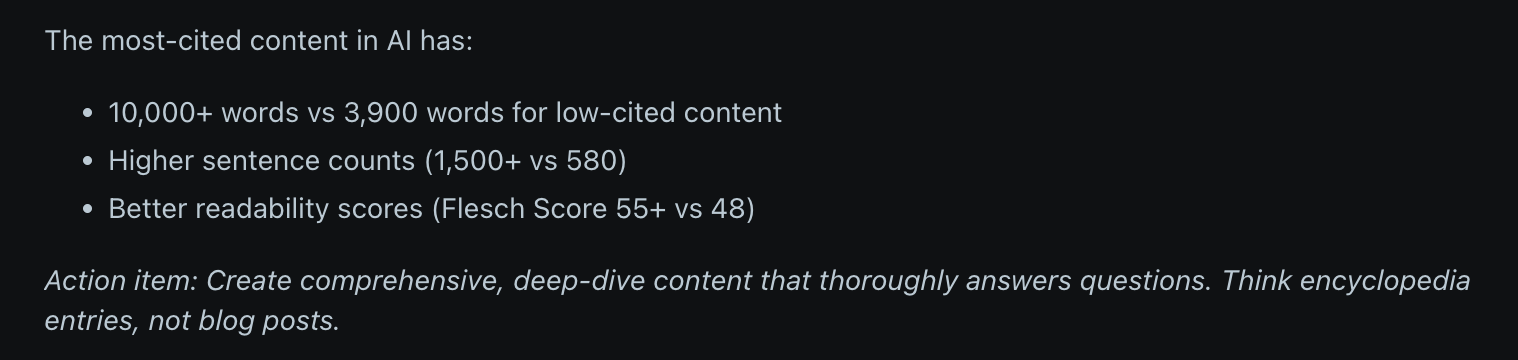
Get the week's best marketing content Email Subscription Subscribe Leave this field empty if you're human: Contents Lately, I’ve seen some particularly bad advice floating around on how long content should be to show up in AI search.For instance, this study of only 20 brands (narrow sample size) is proclaiming that content needs 10,000+ words to be cited by AI.
I’ve also seen others insist very short content (250–500 words) is the future for visibility in AI, arguing that AI models have limited context windows and prefer concise answers (they don’t).
In reality, it’s a chicken-or-egg situation. If most of the internet starts publishing 10,000+ word guides, that’s probably what will get cited. But they won’t get cited because they’re 10,000+ words. They’ll get cited because that’s what’s available (and what “fresh” content starts to look like).
But hey, don’t take my word for it.
In true Ahrefs fashion, we studied 174,000 pages cited in AI Overview responses to see what actually matters. Spoiler alert: there’s almost no correlation between word length and being cited in AI Overviews.
The best thing you can do is write as much as you need to convey your topic to your human audience concisely.
Trim the fluff, get straight to the point, and stop chasing arbitrary word counts “because it’s good for SEO” or “because AI prefers it.”
Key findings
- The average length of content cited in AI Overviews is 1282 words. This is slightly above the current average of content ranking in Google’s organic results, which is 1188 words.
- There is a near-zero correlation between word length and being cited in AI Overview responses (0.04 Spearman correlation).
- 53.4% of pages cited by AI Overviews are under 1,000 words.
- 30.6% are between 1,000 and 2,000 words.
- Only 16% are over 2,000 words.
The bottom line: content length isn’t a major factor in whether you get cited. Short pages (under 1,000 words), long-form guides (over 2,000 words), and everything in between can all work.
Our methodology We analyzed 560,346 AI Overviews and identified 1,677,876 cited URLs. After filtering for pages where we could successfully extract content, we ended up with 174,048 pages with valid data.For each page, we stripped out HTML and boilerplate content, then measured the word count of the remaining raw text. We also tracked citation position (1–10) within each AI Overview to see whether content length affected where a page appeared in the citation list.
1. Short content is cited slightly more than content over 1,000 words
The average word count of pages cited in AI Overviews is 1,282 words. But averages can be misleading. Here’s how the distribution actually breaks down:
- Under 350 words: 16.6%
- 350–1,000 words: 36.8%
- 1,000–2,000 words: 30.6%
- Over 2,000 words: 16.0%
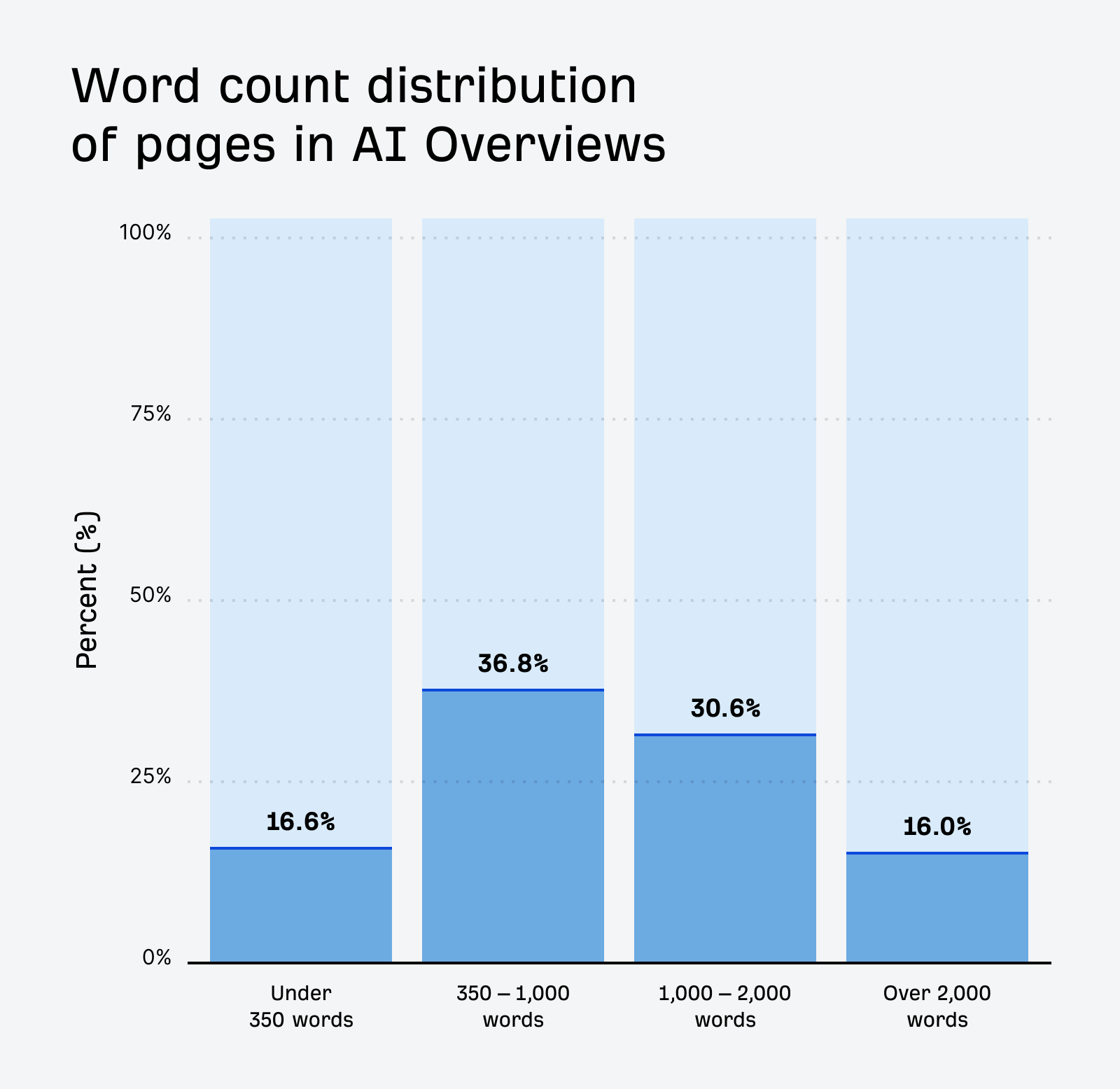
More than half (53.4%) of all citations go to pages under 1,000 words. That’s traditionally considered “short” for blog posts and website content, and well below what most SEO professionals would request in a content brief.
Not exactly the 10,000+ word mega-guides some are recommending.
2. Content length does not seem to affect AI citation position
If longer content doesn’t get cited more often, maybe it at least ranks higher within AI Overviews? Nope.
The Spearman correlation between word count and citation position is 0.04 — essentially zero.
Here’s the average word count by position:
- Position 1: 1,270 words
- Position 2: 1,291 words
- Position 3: 1,291 words
- Positions 4–10: 1,690 words
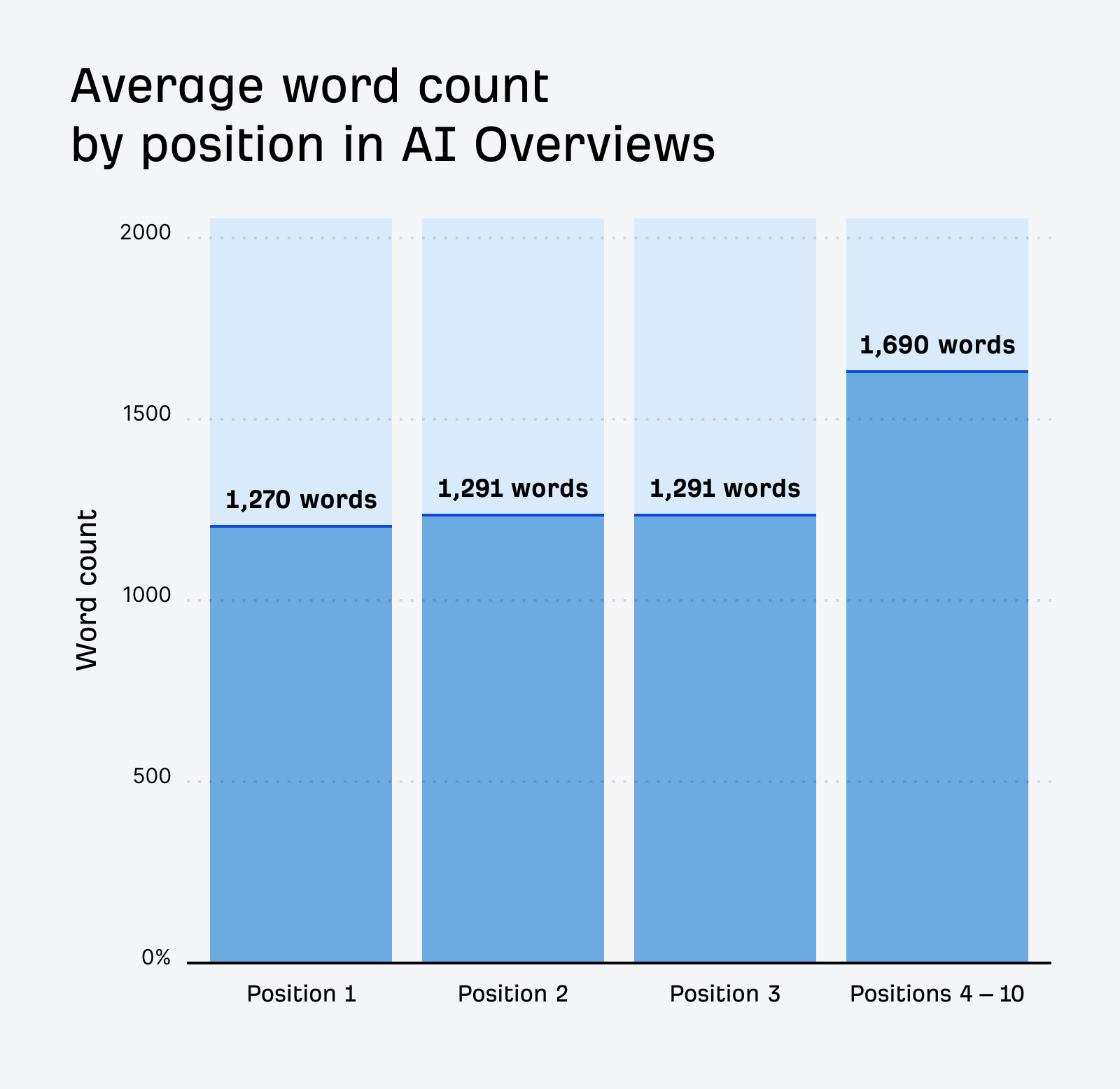
There’s no meaningful difference in content length between the top three citation positions, though the correlation is so weak it’s barely worth considering.
3. Short content is often cited in top positions
When short content gets cited, its distribution across positions closely mirrors that of longer content.
For pages under 350 words:
- 34% appear in position 1
- 32% appear in position 2
- 31% appear in position 3
Pages between 350 and 1,000 words show a similar pattern:
- 30% in position 1
- 32% in position 2
- 34% in position 3
Over 95% of short content citations land in the top three positions. This suggests that when short content gets cited, it competes on equal footing with longer content for prominent placement in AI Overviews (and wins the battle).
4. Most content types have median word counts under 1,000
Averages can be skewed by outliers. Medians give a better sense of what most cited pages actually look like.
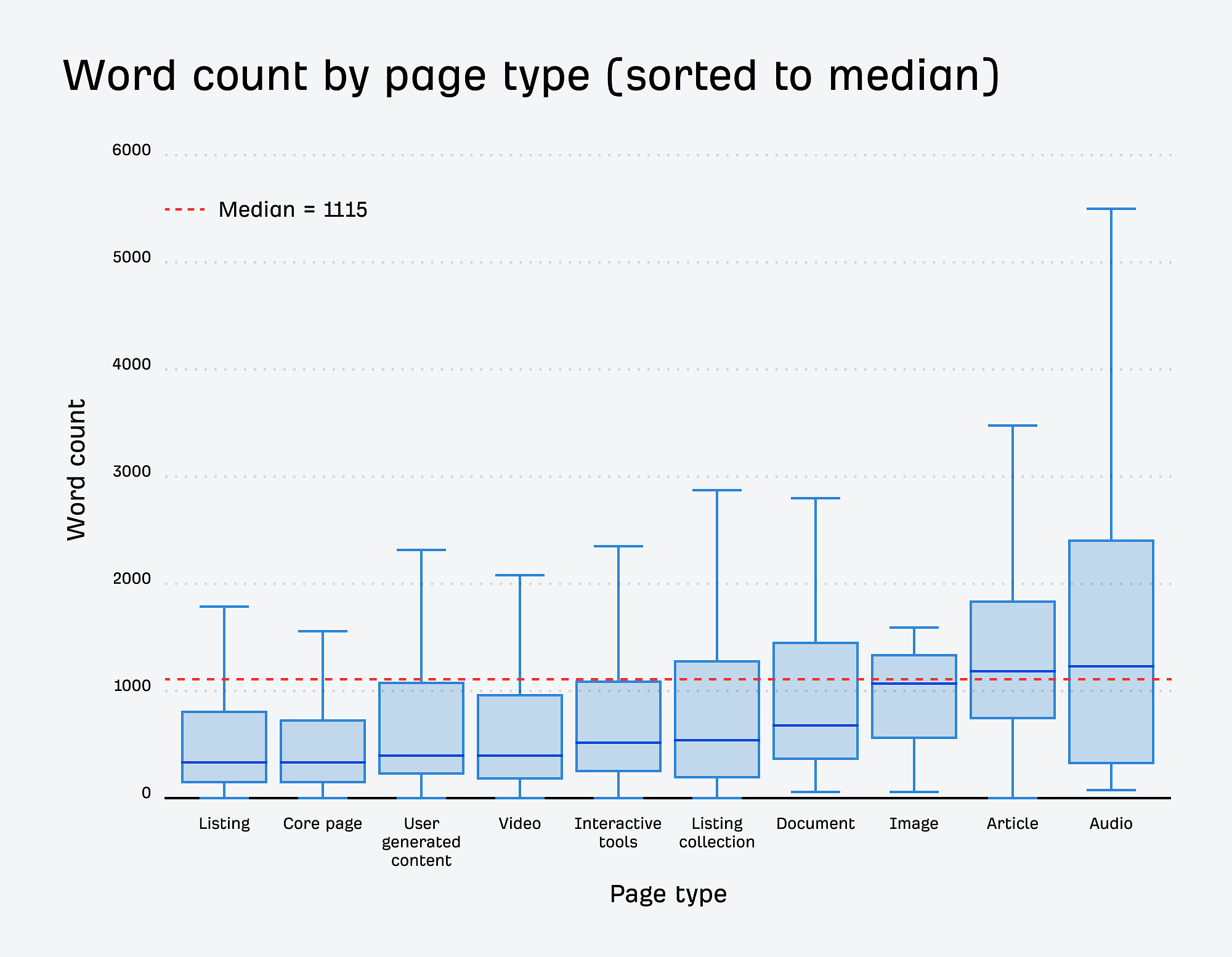
Here’s the median word count by page type:
Content FormatDescriptionMedian Word CountListingsEcommerce or marketplace listing pages.315 wordsCore PagesFundamental website pages like Home, About and service landing pages.317 wordsUser-generated contentComments, posts and content generated by users on platforms like social media or Reddit.387 wordsVideoVideo descriptions and transcripts where available.407 wordsInteractive toolsContent within or surrounding online, interactive content, like calculators or free tools.507 wordsListing CollectionsEcommerce collection and product category pages.534 wordsDocumentsPDFs, slides and similar documents in various file formats.676 wordsArticlesBlog posts and web articles.1166 wordsAudioMainly podcast transcriptions.1226 wordsOnly Articles and Audio have a median higher than 1,000 words. (Audio pages are typically podcast transcriptions, which can run long. For instance, a 30+ minute conversation can be over 5,000 words.)
The median values of transactional and utility content (such as core pages, listings, and listing collection pages) typically range from 300 to 550 words and are still frequently cited. This matters for ecommerce and other non-blog content. You don’t need a 1,000+ word SEO-optimized buying guide to show up in AI Overviews. Match the format to the intent.
One more note: the overall median of 1,115 words is pulled up by the heavy representation of Articles and Audio files in our dataset. The longest blog post cited was around 3,500 words, and many audio files were between 3,000 and 5,500 words.
However, despite what some are suggesting, we’re not seeing 10,000+ word mega-guides dominating AI citations (at least not yet).
What this means for content strategy
Content length alone won’t get you cited in AI Overviews. So what should you focus on instead?
- Answer the query directly. Give people (and search systems) what they want early. Don’t bury the lede.
- Prioritize structure and clarity. Use headings, lead with your main point, and write in declarative sentences that are easy to parse.
- Write for humans first. No one is actually reading a 10,000+ word guide start to finish. If your content doesn’t get engagement, it won’t send the signals that influence search visibility in the first place.
- Match length to the content type. A product page doesn’t need 2,000 words. A comprehensive guide might. Let the topic and format dictate the length, not an arbitrary word count target.
Both short-form and long-form content have their place. The goal is to write as much as you need to answer the question or cover the topic thoroughly. No more, no less.
Stop obsessing over word count and focus on actually answering the query instead.
Copy link
Article PerformanceData from Ahrefs- Linking websites 38
The number of websites linking to this post.
This post's estimated monthly organic search traffic.
Get the week's best marketing content Email Subscription Subscribe Leave this field empty if you're human:
 Article by Despina Gavoyannis Contributors
 Despina Gavoyannis is a Senior SEO Specialist at Ahrefs, a leading marketing platform for search, AI, and beyond. She has worked in SEO for over 10 years, specializing in revenue-driven strategies and collaborating closely with cross-functional teams, including UX designers, developers, and marketers.ContributorsKeep Learning 80% of Our AI Search Traffic Goes to Our Homepage, Product Pages, and Free Tools For years, Google and Bing have told SEOs to focus on users and create great content. They’re saying the same thing for the AI era, but is it true? 76% of AI Overview Citations Pull From Top 10 Pages We studied 1.9M citations from 1M AI Overviews to find out how much AI presence aligns with search visibility. What Triggers AI Overviews? 86 Factors and 146 Million SERPs Analyzed We analyzed 146 million SERPs to see how often AI Overviews appeared for 86 different keyword traits, from YMYL to CPC to query length. I Analyzed 300K Keywords. Here’s What I Learned About AI Overviews I analyzed 300K keywords to understand what triggers AI Overviews. The results were predictable in some ways and wholly surprising in others. Marketers Using AI Publish 42% More Content [+ New Research Report] We surveyed 879 marketers to understand how generative AI is changing content marketing: the workflows, the costs, the results…and the risks. The Ultimate 82-Point Checklist for SEO & AI Visibility Download the ultimate checklist with 82 actionable SEO and AI search tasks. Boost rankings, future-proof your strategy, and stay ahead in tomorrow's search landscape. Search English EnglishDeutschEspañolFrançaisItalianoPortuguês中文日本語 © 2025 Ahrefs Pte Ltd.Pick a topic Marketing AI Search SEO Data & Studies Product Ahrefs Tools Core Tools Free Tools
- Website Authority Checker
- Keyword Rank Checker
- Broken Link Checker
 Join the Ahrefs' DigestGet the week's best marketing content in your inbox. Email Subscription Subscribe Leave this field empty if you're human: Thanks!Please check your email inbox and spam folder. We've sent you a link to verify your email.
 Got It

Login to comment
To post a comment, you must be logged in. Please login. Login
Comments (0)