Sponsored
Computing
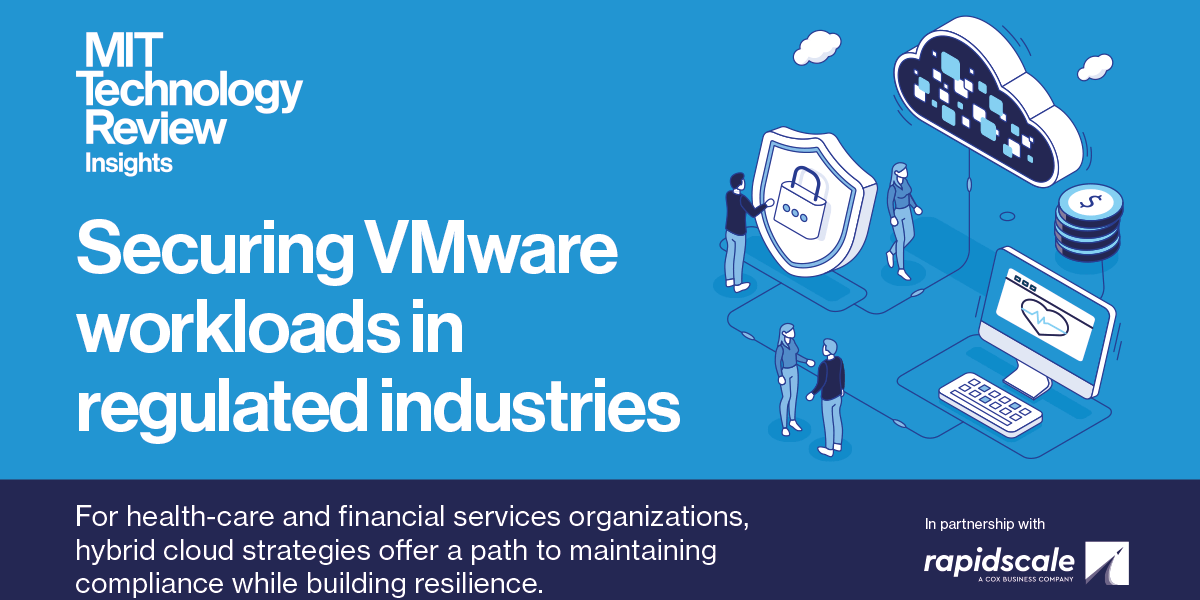
Securing VMware workloads in regulated industries
For health-care and financial services organizations, hybrid cloud strategies offer a path to maintaining compliance while building resilience.
By
- MIT Technology Review Insightsarchive page
December 10, 2025
In partnership withRapidScale
At a regional hospital, a cardiac patient’s lab results sit behind layers of encryption, accessible to his surgeon but shielded from those without strictly need-to-know status. Across the street at a credit union, a small business owner anxiously awaits the all-clear for a wire transfer, unaware that fraud detection systems have flagged it for further review.
Such scenarios illustrate how companies in regulated industries juggle competing directives: Move data and process transactions quickly enough to save lives and support livelihoods, but carefully enough to maintain ironclad security and satisfy regulatory scrutiny.

DOWNLOAD THE ARTICLE
Organizations subject to such oversight walk a fine line every day. And recently, a number of curveballs have thrown off that hard-won equilibrium. Agencies are ramping up oversight thanks to escalating data privacy concerns; insurers are tightening underwriting and requiring controls like MFA and privileged-access governance as a condition of coverage. Meanwhile, the shifting VMware landscape has introduced more complexity for IT teams tasked with planning long-term infrastructure strategies.
Download the full article
This content was produced by Insights, the custom content arm of MIT Technology Review. It was not written by MIT Technology Review’s editorial staff.
This content was researched, designed, and written by human writers, editors, analysts, and illustrators. This includes the writing of surveys and collection of data for surveys. AI tools that may have been used were limited to secondary production processes that passed thorough human review.
by MIT Technology Review Insights
Share story on facebookShare story on email
Popular
- We’re learning more about what vitamin D does to our bodiesJessica Hamzelou
- How AGI became the most consequential conspiracy theory of our timeWill Douglas Heaven
- OpenAI’s new LLM exposes the secrets of how AI really worksWill Douglas Heaven
- Meet the man building a starter kit for civilizationTiffany Ng
Keep Reading
Most Popular
We’re learning more about what vitamin D does to our bodies
The sunshine vitamin could affect your immune system and heart health.
By
- Jessica Hamzelouarchive page
How AGI became the most consequential conspiracy theory of our time
The idea that machines will be as smart as—or smarter than—humans has hijacked an entire industry. But look closely and you’ll see it’s a myth that persists for many of the same reasons conspiracies do.
By
- Will Douglas Heavenarchive page
OpenAI’s new LLM exposes the secrets of how AI really works
The experimental model won't compete with the biggest and best, but it could tell us why they behave in weird ways—and how trustworthy they really are.
By
- Will Douglas Heavenarchive page
Meet the man building a starter kit for civilization
Marcin Jakubowski is compiling a DIY set of society’s essential machines and making it open-source.
By
Stay connected
Illustration by Rose Wong
Get the latest updates from
MIT Technology Review
Discover special offers, top stories,
upcoming events, and more.
Enter your emailPrivacy Policy
Thank you for submitting your email!
Explore more newsletters
It looks like something went wrong.
We’re having trouble saving your preferences.
Try refreshing this page and updating them one
more time. If you continue to get this message,
reach out to us at
customer-service@technologyreview.com with a list of newsletters you’d like to receive.



Comments (0)